Open your server's SSH auth log. Go ahead: grep "Failed" /var/log/auth.log | wc -l. Thousands of attempts. Every night. From IPs you've never heard of. Your lock held. But the door is on a public street, and every stranger on the internet knows exactly where it is.
This series is about changing that. Not hardening the door. Removing it from the street entirely. ZeroTier is the tool. But first: why does the current model fail, and what does it cost you?
Problem 1: The Bouncer Problem
When you expose SSH, RDP, or any admin port to the public internet, you're hiring a bouncer. Strong password policy, key-based auth, fail2ban: that's your bouncer. Most nights, he holds the line.
The problem: the bouncer only controls who gets in. He can't stop someone from walking up to the door. And when a CVE drops in OpenSSH, RDP, or the VPN daemon itself, the attacker doesn't need to get past the bouncer; they exploit the door frame itself.
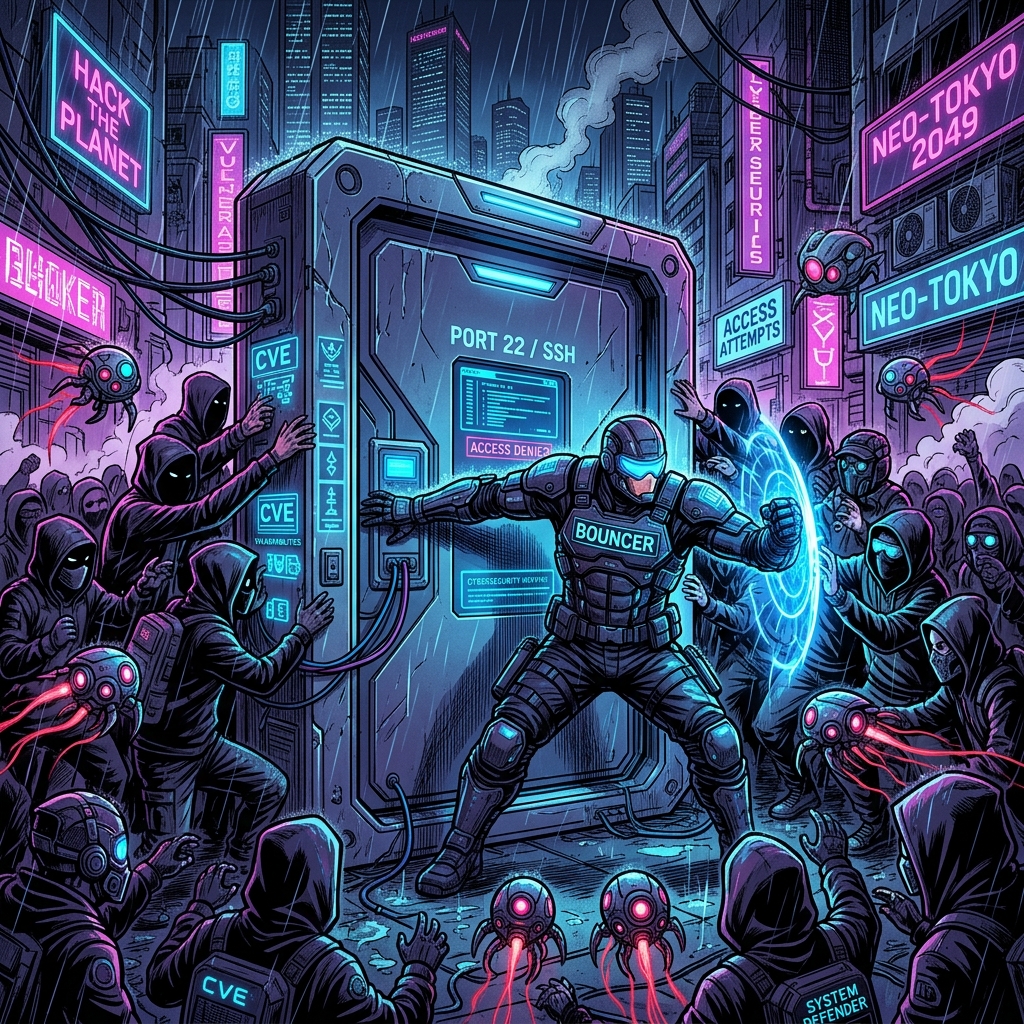
The cost: Someone monitors those logs. Someone patches CVEs on a deadline. Someone gets paged at 3am. That's ongoing ops overhead to maintain a door that shouldn't be on a public street.
Problem 2: Traditional VPN. You Moved the Door, Not the Street
VPN sounds like the fix. Put everything behind a gateway, force all access through the tunnel. Your services are off the public internet. Problem solved?
Not quite. The VPN gateway still has to sit on a public address to accept incoming connections. You didn't remove the target; you consolidated it. Now the gateway is what everyone attacks. And enterprise VPN appliances have had some of the worst CVEs in recent memory: Fortinet, Pulse Secure, Cisco ASA. The vendors you're paying to protect you become the attack surface.
Then there's the inside problem. Once someone is past the VPN gate, they're in a flat network. A compromised laptop, a stolen credential: that device can reach everything behind the perimeter. Security teams call this the "assumed breach" problem. The perimeter model has no answer for it.
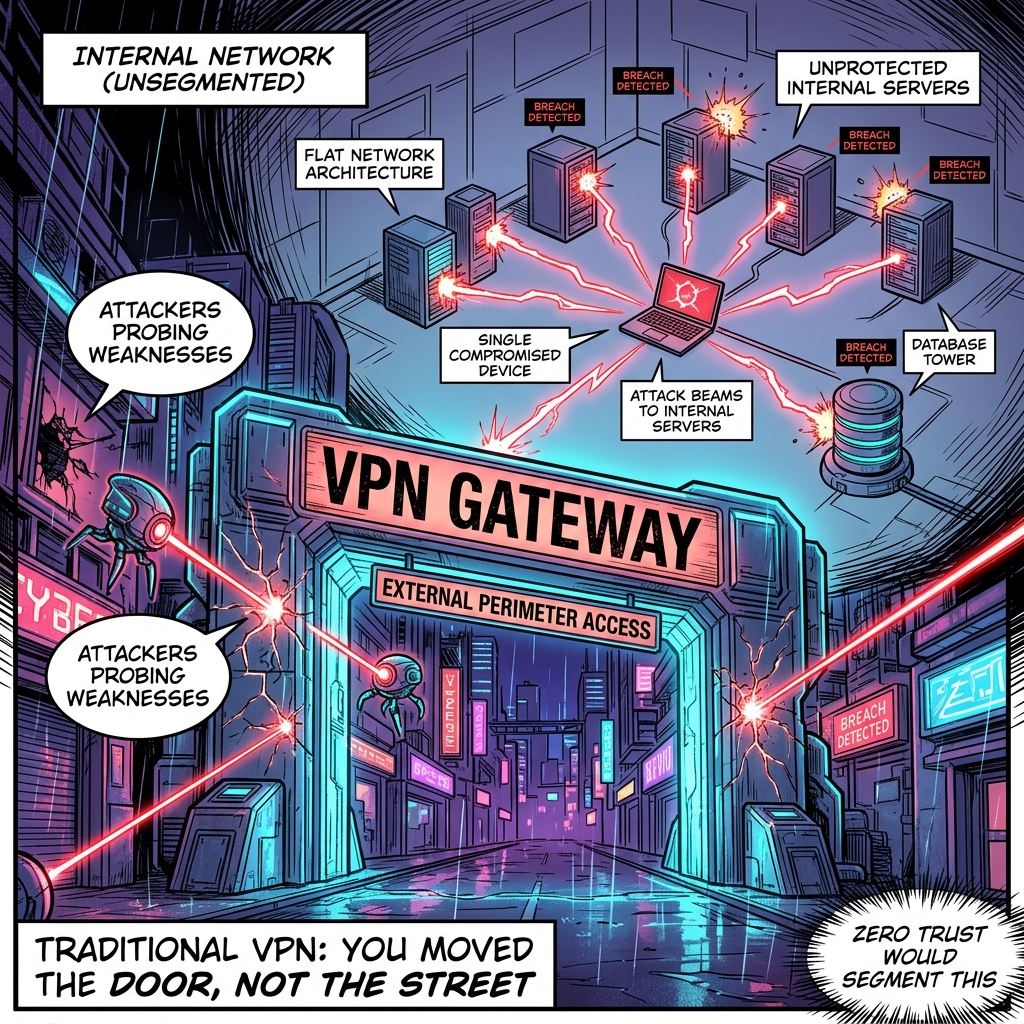
The cost: Enterprise VPN hardware runs $10K-$100K+ in licensing and annual support. Network engineers to manage config distribution as users and nodes change. And the gateway itself needs constant patching; you're paying to maintain another attack surface.
Who Is This For?
If you run a home lab or are working toward a security certification, ZeroTier gives you production-grade private networking on student-grade hardware. You can replicate real-world segmented architectures across a few cheap VPS nodes and actually understand what you are building, not just follow a recipe.
If you are a developer or architect evaluating infrastructure, this series covers the cost model, the trust model, and the operational tradeoffs honestly. ZeroTier is not the right tool for every situation. The goal is enough depth to make an informed call, not a sales pitch.
If you lead a team and want to move faster on zero-trust networking without a six-figure hardware budget or a dedicated network engineer, the self-hosted path in this series is built for you. A $5 VPS, an afternoon, and you own the keys. The next section explains how.
The Shift: No Street Address
The bouncer problem and the VPN problem share a root cause: perimeter thinking. There's a line. Inside is trusted, outside is not. The security model is about defending that line, whether it's the auth daemon or the VPN gateway.
ZeroTier takes a different position entirely. What if your services had no public address at all? Not a locked door. No door on any street anyone can find.
Here's how it works: each node gets a cryptographic identity. The controller (which you self-host) decides which identities are allowed into the network. When an approved node joins, the address exists for it, and only for it. Scanners can't find your SSH port because it isn't bound to your public interface. Shodan doesn't list it. There's nothing to probe.
The cost: ZeroTier is free up to 25 nodes on their managed tier. Self-hosted controller (which is what this series covers) runs on a $5/month VPS with no node limit and no vendor dependency. No gateway hardware. No license. Adding a node is an API call. Revoking is one flag flip. You own the keys.
Zero-Trust: Think of It Like Chat Rooms
Removing the public address solves external exposure. But what stops lateral movement once a node is inside? ZeroTier's answer is isolation by default. Think of each ZeroTier network as a private, encrypted group chat. Only nodes the controller explicitly approves can join. A node in one network cannot see or reach nodes in a different network, even if both run on the same physical server.
This is micro-segmentation at the device identity layer. Your development environment, your production database cluster, your payment processing nodes: each lives in its own chat room. A compromised dev node cannot reach prod. A stolen credential from one environment does not open any door in another.
Within a single network, ZeroTier flow rules add another layer. You can specify that the web frontend can only reach the API server on port 443, and the API server can only reach the database on port 5432. No other paths allowed. This is not a firewall on a perimeter: it is identity-aware, policy-enforced routing baked into the network fabric itself.
Device Identity, Decoupled from User Identity
Segmentation contains a breach once inside. Device identity goes further: it prevents the wrong device from entering at all. Traditional network auth asks "who are you?" and accepts a password as proof. ZeroTier asks "which device are you?" and requires a cryptographic key only that device holds.
Every ZeroTier node generates a unique identity key pair on first install. Its 40-bit network address is derived from the public key hash. You cannot claim another node's address without its private key. A stolen password does not get an attacker onto the network from a different machine.
This is where ZeroTier's threat model diverges sharply from a shared-credential VPN. A compromised password in a traditional VPN grants any device full network access. In a ZeroTier network, the password is irrelevant. The controller authorizes specific devices. Access follows the device, not the account.
There is a deeper advantage here. When a user's credentials are stolen and used from an unrecognized device, traditional auth cannot distinguish that from a legitimate login. The password matched. ZeroTier can. The attacker's device carries a key the controller has never authorized. The connection fails in a way that is precisely attributable: valid user identity, wrong device identity. That is not just access control. That is anomaly detection baked into the network layer. Cross-reference your user activity logs with device identity and you have a concrete breach signal before any damage is done.
"Isn't the Controller Just Another Bouncer?"
The segmentation and device identity arguments are compelling. A skeptical reader will ask the obvious question: if ZeroTier removes the public door, doesn't the controller itself become the door? The ZeroTier controller daemon listens on port 9993 UDP. If you self-host, that port is reachable from the internet. It sounds like the bouncer problem in a different shirt.
The difference is what happens at that port. With SSH, there is an unauthenticated handshake phase: the daemon processes attacker-controlled input before identity is ever checked. That is where pre-auth CVEs live. ZeroTier's protocol does not have that phase. Every packet carries a cryptographic signature tied to the sending node's identity. The daemon validates the signature before it processes anything. There is no unauthenticated surface to exploit first.
The management plane is a separate concern entirely. The web UI and API that actually authorize nodes do not need to face the internet at all. You can run the management interface on localhost, or behind a ZeroTier network the controller itself manages. The door that grants access to the network can live inside the network it protects.
Coming up in this series
For every how-to guide, I will pair the write-up with a skills-based AI agent prompt. Instead of copy-pasting shell commands from a blog and hoping your environment matches mine, you run the skill with your own AI agent. It adapts to your setup, catches your errors, and gets you to a working state fast. From zero to a self-hosted ZeroTier controller: under 30 minutes, no network engineering background required.