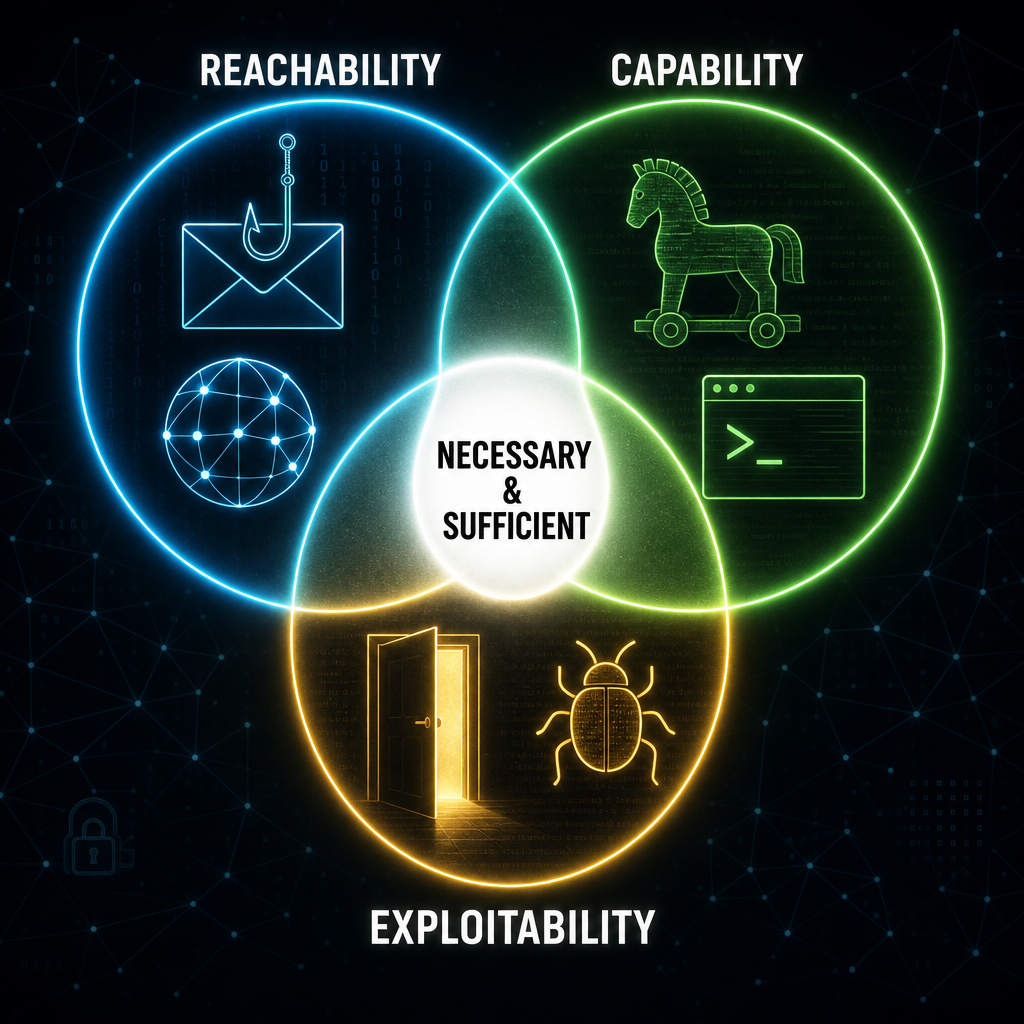
Defending systems against modern adversaries requires moving beyond standard compliance checklists. By applying the first principles of formal logic, we can construct threat models that dictate target defense strategies based on necessary and sufficient conditions.
In chemistry, a fire requires three components: Oxygen, Fuel, and Heat. Remove one, and the fire collapses. In cybersecurity, system compromise (C) follows the exact same logical conjunction:
No single factor can cause a compromise on its own. An attack only succeeds when all three overlap.
Most corporate defense programs spend millions of dollars attempting to eliminate Exploitability (chasing and patching thousands of CVEs) or detect Capability (matching signatures of attacker payloads). This is an unsustainable posture:
To defend systems effectively, we must target the only variable under our direct engineering control: Reachability (Threat Accessibility).
By wrapping administrative entry points completely inside private, encrypted overlay networks, we force external Reachability to false. This is not patching a vulnerability. It is eliminating the routing path entirely, shrinking the attack surface to zero for external actors.
Because Compromise = Reachability AND Capability AND Exploitability, if Reachability = false, then Compromise is mathematically guaranteed to be false. It doesn't matter how high the adversary's Capability is, or how susceptible the system remains.
This simple architectural shift inverts the cost asymmetry: defenders configure overlays for free, while attackers are forced to spend enormous sums attempting to buy credentials or hijack endpoints to restore routing access.
Evaluating single entry points is only the foundation. Real-world intrusions unfold across multi-stage action chains: from initial network infiltration to autonomous agent exploitation. See how necessary and sufficient conditions apply across each phase of the attack loop.
Read "The Attack Life Cycle: Mapping Adversary Action Chains" →